Entrepreneurship for TVET Professionals

Date: September 11-15, 2022 /
Program Type: In-Country Program /

Main Contents

Theme Papers


  • Theme Paper 1: Blue Ocean Strategy for Entrepreneurship Promotion in TVET
  • Theme Paper 2: Environmental Scanning and Business Opportunity Identification
  • Theme Paper 3: Innovation and Technology Business Incubation
  • Theme Paper 4: Social, Rural and Women Entrepreneurship
  • Theme Paper 5: Formulation of Business Plan
  • Theme Paper 6: Financing Schemes for Industry/Business setup by TVET Professionals
  • Theme Paper 7: Management of Micro, Small and Medium (MSME) Enterprises
  • Theme Paper 8: Industry-Academia Linkages for Entrepreneurship Development

Tasks and Project Work


  • Task 1: Self Analysis for Becoming Entrepreneur
  • Task 2: Identification of Internal and External Factors in Successful Bangladesh Entrepreneurs
  • Task 3: Identification of Internal and External Factors in Successful International Entrepreneurs
  • Task 4: Case Study of Business Incubator in a Technical Institution in Bangladesh
  • Task 5: Experience sharing of Entrepreneurship Activities in TVET institutions of Bangladesh, Suggestions and the Road Ahead
  • Project Work: Action Planning for Intensifying Entrepreneurship in TVET Institutions of Bangladesh

Crafting a Culture of Quality Assured TVET in Nepal and Institution-Industry Collaboration for Employability

Date: August 22-26, 2022 /
Program Type: Customized Program /

Main Contents

Special Lecture: 21st Century Skills: Skills and Enablers for TVET 4.0


Topics


  1. Institution-Industry Linkage
  2. Benefits from Institution-Industry Collaboration
  3. Models of Effective Institution-Industry Collaboration
  4. Quality Assurance and Accreditation in TVET
  5. Tracer Study in TVET
  6. Action Planning

Theme Papers


  • Theme Paper 1: Institution-Industry Linkage: A Real Need of the Time and Benefits Derived
  • Theme Paper 2: Models of Effective Institution-Industry Collaboration
  • Theme Paper 3: Quality Assurance and Accreditation in TVET for Continuous Improvement and Attaining Status of Excellence
  • Theme Paper 4: Research in TVET
  • Theme Paper 5: System Development through Action Planning

Individual Work: Self-Assessment for Leadership Competence


Group Work


  • Group Work 1. Gap Analysis/ SWOT Analysis: Overview of the Current TVET Landscape
  • Group Work 2. Developing a Draft Tracer Study Instrument
  • Group Work 3. System Development Planning: Action Plan the Way Forward

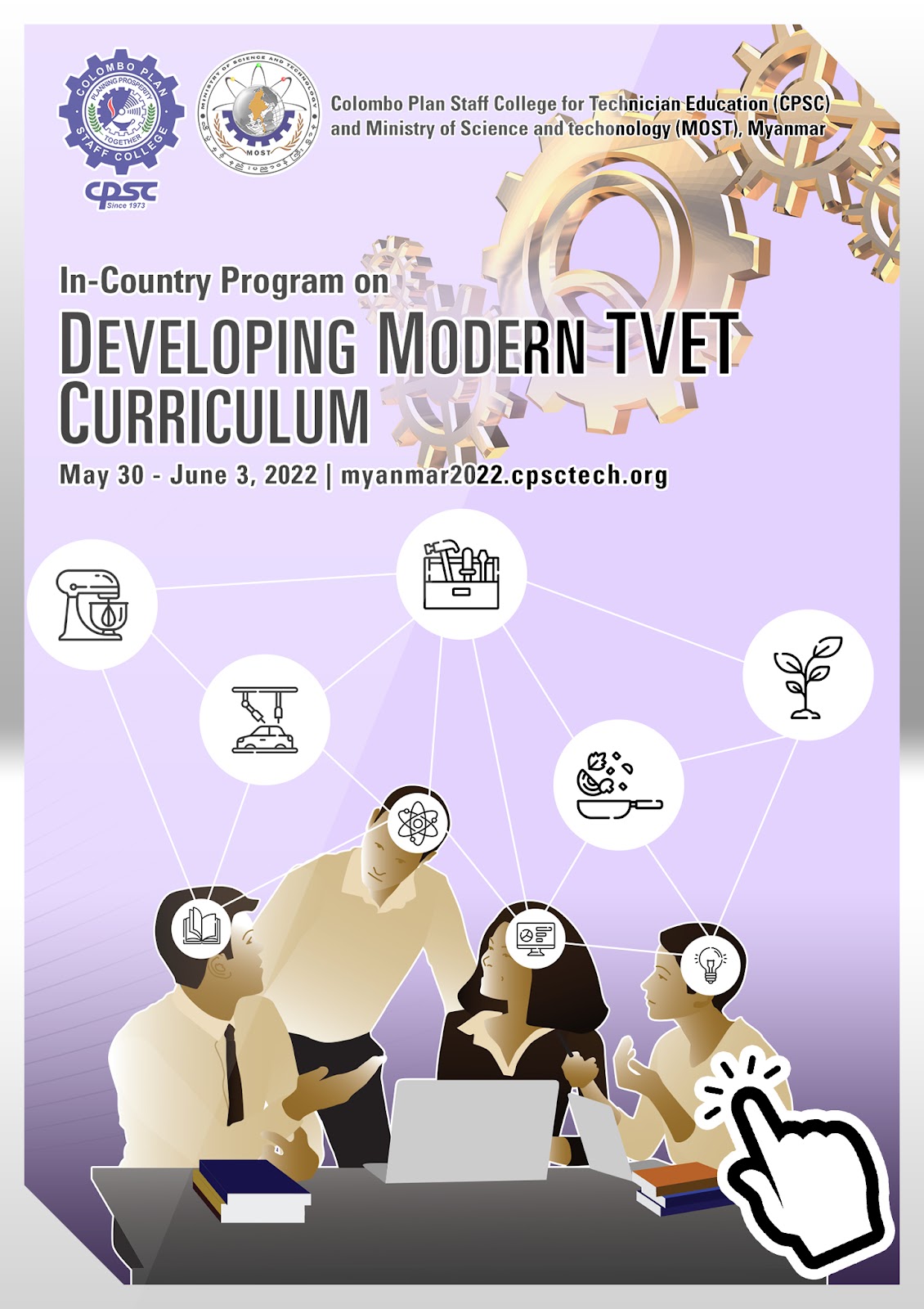
Developing Modern TVET Curriculum

Date: May 30 - June 3, 2022 /
Program Type: In-Country Program /

Main Contents

Special Lecture: Skills Development for the Post-COVID Digital Economy. This special lecture will contribute to ongoing discussions on how the pandemic and emerging technologies are transforming job markets, determining new skills sets requirements and driving the digital economy.


Theme Papers


  • Theme Paper 1: Understanding Competency-Based Training. The first theme paper provides an overall understanding of key CBT concepts and practices. Definitions of competence, qualifications, and qualifications framework as well as CBT processes and structures will be discussed.
  • Theme Paper 2: Identifying Priority Occupations. The second theme paper discusses this first stage of CBT and its two steps: skills needs assessment and training needs analysis. Skills needs assessment identifies the differences between the skills required – by whom, for what job, for which product or service market, in what quantity, and when – and the training available – for which population, at what cost, for what job and for which product or service market. Training needs analysis refer to the technical and vocational skills gaps that need to be addressed to employment in the labour market.
  • Theme Paper 3: Identifying competencies. The third theme paper explains the three-step process of identifying the competencies and competency standards that will later be used by learners and training providers. The steps include: (a) identifying competencies using occupational analysis; (b) verifying the occupational profile; and (c) developing competency standards.
  • Theme Paper 4: Designing CBT Programmes. The fourth theme paper illustrates the actual processes of designing CBT programmes. The paper describes the procedures of developing curriculum and learning tools as well as the designing CBT for workplace-based learning
  • Theme Paper 5: Developing a Curriculum Framework. The fifth theme paper explains how competency standards are transformed into a curriculum framework. The framework consists of the module design with learning outcomes and content, teaching and learning strategies, assessment criteria and modes of assessment. The paper also details the translation of the curriculum framework into learner guides that will form the basis of training delivery. Instructions on designing job sheets and session plans will also be tackled in this paper.

Group Work


  • Group Work 1. Brainstorming on the Implications of the Digital Economy Megatrends to Skills Demand and Supply
  • Group Work 2. Developing a DACUM Chart
  • Group Work 3. Writing a Unit of Competency
  • Group Work 4a. Writing Program Design
  • Group Work 4b. Writing Learning Outcomes
  • Group Work 4c. Developing Learning Tools
  • Group Work 5: Presenting the Curriculum Framework

Prologue to Accreditation: APACC International Accreditors’ Refresher Training Program

Date: March 28 - April 1, 2022 /
Program Type: Online Program /

Main Contents

  • Overview of APACC and Status Report
  • Desirable Characteristics of APACC Team and Rules in Institutional Evaluation
  • Updates on APACC Criteria
    • Criterion I: Governance and Management
    • Criterion II: Teaching and Learning
    • Criterion III: Human Resources
    • Criterion IV: Research and Development
    • Criterion V: Image and Sustainability
    • Criterion VI: Other Resources
    • Criterion VII: Support to Students
  • Roles and Responsibilities of APACC Team before, during, and after institutional evaluation
  • Parts of Evaluation Report and Tips in Report Writing

Project Management in TVET

Date: March 21-25, 2022 /
Program Type: In-Country Program /

Main Contents

Theme Papers


  • Special Lecture: Revisiting Global Trends and Challenges in TVET: Reflections for Project Identification
  • Theme Paper 1: Basics of Project Management
  • Theme Paper 2: Identifying and Conceptualizing Projects
  • Theme Paper 3: Developing the Project Proposal
  • Theme Paper 4: Project Implementation and Monitoring
  • Project Evaluation and Closure

Refresher Training on the 2020 APACC Manual: Charting The Quality Future of PCC TVET Institutions

Date: March 14-17, 2022 /
Program Type: Online In-Country Program /

Main Contents

Theme Papers


  • Overview and Rationale of Updates on APACC Instrument and Procedures
  • Orientation on the new APACC Criteria
    • Criterion I: Governance and Management
    • Criterion II: Teaching and Learning
    • Criterion III: Human Resources
    • Criterion IV: Research and Development
    • Criterion V: Image and Sustainability
    • Criterion VI: Other Resources
    • Criterion VII: Support to Students
  • Roles and Responsibilities of Internal APACC Team before, during, and after institutional evaluation
  • Parts of Evaluation Report and Tips in Report Writing
  • Preparation for reaccreditation
  • Developing an Institutional System Development Plan

Accreditation and Certification in Achieving Quality-Assured TVET

Date: February 7-11, 2022 /
Program Type: Online Special Program /

Main Contents

Theme Papers


  • Theme Paper 1: Overview of TVET Quality Assurance System
  • Theme Paper 2: Program Accreditation as Quality Assurance for TVET Programs
  • Theme Paper 3: Accreditation Criteria and Teaching-Learning Processes
  • Theme Paper 4: Institutional Accreditation as Quality Assurance for TVET Institutions Operations and Work Procedure
  • Theme Paper 5: Course wise and Program wise outcomes
  • Theme Paper 6: Attainment of COs and POs
  • Special Presentation: APACC Accreditation as External Quality Assurance
  • Theme Paper 7: The Role of the Skills National Assessment and Certification System as Quality Assurance
  • Theme Paper 8: Students, Faculty and Facilities
  • Theme Paper 9: Establishing Quality Assurance System in the TVET Institutes.

Group Work Activities


  • G/IWA 1: Answer Online Quiz
  • G/IWA 2: Answer Self-Assessment Checklist to determine the level of Quality Assurance System in Delivering Programs
  • G/IWA 3: Answer Online Quiz
  • G/IWA 4: Determine the TVI readiness to undergo APACC Institutional accreditation
  • G/IWA 5: Answer Online Quiz
  • G/IWA 6: Develop Action Plan
  • Self-assessment report and accreditation visit

IR 4.0 Engineering in TVET: Infrastructure Design and Pedagogy Innovation

Date: December 21, 2021 /
Program Type: Webinar /

10:00am Afghanistan | 10:30am Maldives, Pakistan | 11:00am India, Sri Lanka | 11:15am Nepal | 11:30am Bangladesh, Bhutan | 12:00nn Myanmar | 12:30nn Thailand | 1:30pm Malaysia, Mongolia, Philippines, Singapore | 3:30pm Papua New Guinea | 5:30pm Fiji


Background


In the new Digital infrastructure world, the demand for 'industry ready skilled and trained resources' are ever on the raise. With the Infrastructure world staying in the low per-capita productivity area in comparison to other leading industries, the infrastructure industry owners are looking for 'Digitally Skilled' and industry trained resources to meet their productivity needs. In this brief talk, we would first take you through the evolution of Digital processes in the complete life-cycle of Infrastructure industry. And then we would relate it to career opportunities and learning pedagogy opportunities that exists in this new world of Digital Infrastructure Engineering. We will also talk about how the Bentley Education program can help you develop engineering skills for the real world and take the next step in your career!


Sustainable City Development through SMART Transportation in Busan

Date: December 7-10, 2021 /
Program Type: Online Program /

Main Contents

Presentations:


  • Korea’s Process of Urbanization and the Changes of Urban Development Policies
  • The direction and Strategy of Smart City Policies in Korea & A Case Study on Busan
  • The Direction & Strategy of Intelligent Transportation System (ITS) Policies in Korea
  • A Case Study on Intelligent Transportation System (ITS)
  • Smart Mobility in 4th Industrial Revolution Era
  • Brief Sharing of Country Situations
  • [BFIC Presentation] Development Cooperation and City Development

Readiness of TVET for IR 4.0

Date: November 29 - December 3, 2021 /
Program Type: Online In-Country Program /

Main Contents

  1. TVET 4.0 to Address IR 4.0 covering: 21st Century skills; Skills and Enablers in TVET 4.0
  2. Concepts of IR 4.0, Stages,elements and major trends impacting on TVET 4.0. It shall cover inputs to Teacher Training as well as TVET Research as a Driver for Innovation
  3. TVET Teacher Professional Competency Framework in the Industry 4.0 Era. The VOCTECH SEAMEO Survey will be presented as a case; ASEAN Teaching Model IR 4.0; latest demand-driven occupations and the integration of digital technologies in teaching competencies

Theme Papers


  • Theme Paper 1: Imagineering TVET for the Changing World
  • Theme Paper 2: Concepts of IR 4.0, Stages, elements and major trends impacting on TVET 4.0.
  • Theme Paper 3: Challenge of Industry 4.0 to Teacher Training and to TVET Research as a Driver for innovation
  • Theme Paper 4: TVET Teacher Professional Competency Framework in the Industry 4.0 Era
  • Theme Paper 5: Digital Technologies to Integrate IR 4.0 Skills inTeaching Competencies

Group Work


  • Group Work 1: Gap Analysis /SWOT Analysis: Overview of the Current TVET Landscape
  • Group Work 2: Developing Teaching Aids for a Blended Learning Program
  • Group Work 3: Developing Digital Contents Using Authoring Tools
  • Group Work 4 : System Development Planning: Action Plan The Way Forward

Orientation on Updated APACC Self Study Form and Processes

Date: November 4-5, 2021 /
Program Type: Online Program /

Main Contents

Presentations:


  • APACC Processes and Updates
  • Rationale and Overview of Updates on APACC Instrument and Procedures
  • Criterion 1: Governance and Management
  • Criterion 2: Teaching and Learning
  • Criterion 3: Human Resources
  • Criterion 4: Research and Development
  • Criterion 5: Image and Sustainability
  • Criterion 6: Other Resources
  • Criterion 7: Support to Students

TVET Accreditation as Quality Assurance in Establishing Quality TVET Systems Across the Nations

Date: August 31 - September 6, 2021 /
Program Type: Online Program /

Main Contents

Presentations:


  • Presentation 1: TVET Quality Assurance Practices in Asia and the Pacific
  • Presentation 2: Overview of TVET Quality Assurance System
  • Presentation 3: APACC Accreditation as External Quality Assurance
  • Presentation 4: TVET Accreditation (Institutional and Program) Requirements
  • Presentation 5: Establishing Accreditation as Quality Assurance to Harmonize Quality TVET Standards/Criteria

Group Work Activities:


  • GWA 1: Answering Short Exercises
  • GWA 2: Accreditor’s Performance Task
  • GWA 3: Determine the TVI readiness to undergo accreditation
  • GWA 4: Develop basic accreditation guide

APACC Accreditors’ Training for INDMO, Timor Leste

Date: August 23-27, 2021 /
Program Type: Online Program /

Main Contents

  • Overview of APACC and Status Report
  • Orientation and Workshop on APACC Criteria
    • Criterion I: Governance and Management
    • Criterion II: Teaching and Learning
    • Criterion III: Human Resources
    • Criterion IV: Research and Development
    • Criterion V: Image and Sustainability
    • Criterion VI: Other Resources
    • Criterion VII: Support to Students
  • Desirable Characteristics of APACC Team and Rules in Institutional Evaluation
  • Roles and Responsibilities of APACC Team before, during, and after institutional evaluation
  • Parts of Evaluation Report and Tips in Report Writing

Instructional Design Based on ICT and Digital Technology

Date: August 2-6, 2021 /
Program Type: Online Program /

Main Contents

Online Classes


  • Online Class 1: Fostering 21st Century Skills to Address TVET Needs
  • Online Class 2: ICT Applications in Teaching and Learning Process
  • Online Class 3: Instructional Design Models
  • Online Class 4: Multimedia content preparation for Teaching and Learning
  • Online Class 5: Learning Management System for Online Delivery
  • Online Class 6: Augmented Reality and Virtual Reality Applications
  • Online Class 7: Online Assessment Tools

Project Tasks


  • Project Task 1: Conduct SWOT Analysis on Online Learning
  • Project Task 2: Preparation of Multimedia Content
  • Project Task 3: Develop a LMS (Moodle) for a Course
  • Project Task 4: Preparation of Online Assessment Questions
  • Project Task 5: Preparation of Action Plan

Enhancing TVET Institution and Industry Partnerships for Quality TVET

Date: July 24-28, 2021 /
Program Type: Online In-Country Program /

Main Contents

Online Classes


  • Special Lecture: Post COVID-19 Scenario for Industry Institute Partnership
  • Theme Paper 1: From linkages to Industry-Institution Partnerships in TVET System: Concepts and Principles
  • Theme Paper 2: Innovative Models and Approaches in TVET Industry - Institute Partnership
  • Theme Paper 3: Dual Training System: Concept, Benefits, and Challenges
  • Theme Paper 4: Industry-Institution linkages in TVET system of Myanmar
  • Theme Paper 5: I-I Partnership in Curriculum development and Training programs
  • Theme paper 6: Action Planning for Institute-Industry Partnership for quality TVET

Group Works


  • Group Work 1: Undertake SWOT analysis for Industry - Institute Partnership in the TVET system
  • Group Work 2: Develop strategies for enhancing industry-institution partnership system in the TVET sector
  • Group Work 3: Identify Responsibilities of Institute Management Committee for I-I linkages
  • Group Work 4: Identify the Characteristics of the Best I-I partnership model that suits the Myanmar Context
  • Group Work 5: Preparation of Action Plan for building industry-institute Partnerships in the TVET system


National Seminar on
Public-Private Partnerships: As an Expanding Horizon for Institute-Industry Partnership TVET System of Myanmar
July 26, 2021

View Seminar Brochure

Seminar Presentations

Use of Mentimeter for Learner Centered Learning

Date: June 28, 2021 /
Program Type: Webinar /

9:30am Afghanistan | 10:00am Maldives, Pakistan | 10:30am India, Sri Lanka | 10:45am Nepal | 11:00am Bangladesh, Bhutan | 11:30am Myanmar | 12:00nn Thailand | 1:00pm Malaysia, Mongolia, Philippines, Singapore | 3:00pm Papua New Guinea | 5:00pm Fiji


Webinar Presentations


Presentation
Shaping up TVET: Use of Collaborative Tools for Learner Centered Learning
by Engr. Abdul Ghani Rajput

How China Is Using Artificial Intelligence in Classrooms (Video)
SAMR Model Explained (Video)


Presentation
Importance of Collaborative Tools for Teaching and Learning Process
by Dr. Muhammad Mujtaba Asad


Background


The global impact of Covid-19 is multifaceted and is clearly manifested in almost all sectors, particularly the health, economic and education sectors. Since the announcement of the virus as a pandemic in March 2020, there have been a plethora of daily reports on its impact on the lives of millions across the world. Accordingly, every country’s primary concern has become to diminish the spread of the virus and alleviate its effects on the society in general, and the most vulnerable communities in particular.

In April 2020, a rapid assessment survey was conducted by the ILO-UNESCO-WBG on TVET and described the current state of TVET during COVID-19 period. In this report, current TVET trends highlighted and stated that the TVET sector should have 4E (E-Content, E-Learning, Education Technology and Entrepreneurship).

Technology has become an increasingly important part of students’ lives beyond school, and even within the classroom it can also help increase their understanding of complex concepts or encourage collaboration among peers. Because of these benefits, current educational practice suggests that teachers implement some form of technology in their classrooms – but many teachers face difficulties in doing so. Cost, access, and time often form considerable barriers to classroom implementation, but another obstacle is a lack of knowledge regarding how technology can best be used to benefit students across diverse subject matter.

In this context, Colombo Plan Staff College is planning to organize a webinar on “Use of Mentimeter for Learner Centered Learning''. This webinar will be dedicated to CPSC member countries TVET practitioners to build the capacity on how to use Mentimeter to teach and connect remotely with your students. Learn how to create a presentation, what question types are particularly useful for teachers and how to share it with your students. The other objective of the webinar is to share Technological Pedagogical Content Knowledge (TPACK) and Substitution, Augmentation, Modification, and Redefinition (SAMR) Models to enhance teaching and learning process. The online collaborative tools help to engage learners through innovative presentations. After completion of this webinar, the participants are able to create and setup their own mentimeter presentation. Furthermore, understand the concept and importance of TPACK and SAMR models. The outcome will be aligned with different interpretations and expectations of digital innovation concept from the various stakeholders’ perspectives.


Focus


This webinar aims to build up the capacity of TVET practitioners on how to use collaborative teaching and learning tools to teach and to connect remotely with the students and its importance in teaching and learning process. Learn how to create a presentation, what question types are particularly useful for teachers and how to share it with the students. This webinar will also share ideas on Technological Pedagogical Content Knowledge (TPACK) and Substitution, Augmentation, Modification, and Redefinition (SAMR) Model to enhance teaching and learning process.


Objectives


  • To explain the importance of collaborative tools in the teaching and learning process
  • To demonstrate how to use and setup an interactive presentation – Mentimeter
  • To share the concept of Technological Pedagogical Content Knowledge (TPACK) and Substitution, Augmentation, Modification, and Redefinition (SAMR) models


Industry Institute Partnership for Relevant TVET Program

Date: June 21-25, 2021 /
Program Type: Online Program /

Main Contents

Online Classes


  • Special Lecture: Post COVID-19 Scenario for Industry Institute Partnership.
  • Theme Paper 1: Building Industry-Institution Partnerships in TVET System: Concepts and Principles
  • Theme Paper 2: Interventions to enhance TEVT-Industry Partnerships
  • Theme Paper 3: Innovative Models and Approaches in TVET Industry - Institute Partnership
  • Theme Paper 4: Dual Training System: Concept, Benefits, and Challenges

Group Works


  • Group Work 1: Undertake SWOT analysis for Industry - Institute Partnership in the TVET system
  • Group Work 2: Develop strategies for enhancing industry-institution partnership system in the TVET sector
  • Group Work 3: Identify skills for youth employability in the TVET sector
  • Group Work 4: Preparation of Action Plan for building industry-institute linkages in the TVET system

TVET Institute Management for Global Competitiveness

Date: June 21-24, 2021 /
Program Type: Online Program /

Main Contents

Online Classes


  • Theme Paper 1: TVET Institutes Management for the Global Competitiveness
  • Theme Paper 2: Instructional Management
  • Theme Paper 3: Application of ICT and Digital Skills in Institutional Management and Teaching
  • Theme Paper 4: Management of 21st Century skills and IR 4.0 for TVET programs

Projects Works


  • Project Work 1 & 3: Develop a curriculum structure integrating 21st century skills & IR 4.0
  • Project Work 2: Develop ICT tools or mobile apps for monitoring and teaching

Occupational Safety and Health (OSH) in TVET

Date: June 17, 2021 /
Program Type: Webinar /

June 17, 2021 | 9:30am Afghanistan | 10:00am Maldives, Pakistan | 10:30am India, Sri Lanka | 10:45am Nepal | 11:00am Bangladesh, Bhutan | 11:30am Myanmar | 12:00nn Thailand | 1:00pm Malaysia, Mongolia, Philippines, Singapore | 3:00pm Papua New Guinea | 5:00pm Fiji


Webinar Presentations

Presentation
Occupational Health & Safety: Vital Spark of TVET
by Ramhari Lamichhane, PhD

BASF Occupational Health and Safety (Video)


Presentation
Occupational Safety and Health in TVET
by Engr. Sanyog Bhattarai


Background


This concept paper is prepared for the CPSC webinar on the topic “Occupational Safety and Health in TVET”. The skilled workforce are the major contributors to the economic and social development of the contemporary global society. Unfortunately, their health and safety are often negatively influenced by the working environment, social factors, and behaviours. Although the employers are primarily responsible for providing healthy and safe working environments, the workers are also expected to follow the OSH rules and regulations to prevent work-related injuries and diseases.


Occupational health is a discipline devoted to prevention and management of occupational diseases, accidents and disabilities and to elimination of occupational factors and conditions hazardous to health and safety at work. The goal of an occupational safety and health program is to foster a safe and healthy occupational environment for the students and teachers. OSH also protects all the general public who may be affected by the occupational environment.


The program addresses the incidence of occupational diseases and work-related diseases and injuries among workers through health promotion and protection in all workplaces. It aims to improve workers' access to basic occupational health services at the working contexts.


In TVET, Occupational Safety and Health (OSH) is an interdisciplinary activity concerned with the prevention of occupational risks and hazards inherent to each occupation. OSH programs objectives are to:

  • Secure the health, safety and welfare of employees and other people at work
  • Protect the public from the health and safety risks of commercial activities
  • Eliminate workplace risks and hazards

While TVET education is concerned with the acquisition of knowledge and skills for the world of work, occupational safety and health (OSH) aims at the protection and promotion of safety and health at the workplace. Thus, it is up most important and urgent to train TVET students in OSH at the TVET institute level and after the graduation the students will comply with the OSH on the job.


Thus, it is very important to integrate OSH components in the TVET education and train the students on it and make it habit for the students to follow the rules and regulations of OSH.


Focus


This webinar session is designed to provide concept and knowledge on occupational safety and health, its management in TVET institutions, and need of OSH training to the students. It will also provide knowledge on different subject-wise safety measures & health and provide subject-wise good practices found in the TVET institutions.


Objective


  • Sharing the concept and management guidelines on occupational safety and health program for the TVET institutions.


Training of Trainers for the Future Movers Programme (Batch 2)

Date: May 24-27, 2021 /
Program Type: Online Program /

Main Contents

Theme Papers


  • Theme Paper 1: Effective Teaching and Learning Management of TVET Trainers
  • Theme Paper 2: Vocational Pedagogy Based Instructional Methods and Processes
  • Theme Paper 3: Application of ICT Tools in Effective Training Delivery
  • Theme Paper 4: Demonstrate Instructional Competencies to Impart KSA
  • Theme Paper 5: Effective Sessions Plan

Micro-Teaching (Project Work)


  • 5 minutes microteaching by the participants (individual project)