Showing posts with label Philippines. Show all posts

Readiness of TVET for IR 4.0

Date: November 29 - December 3, 2021 /
Program Type: Online In-Country Program /

Main Contents

  1. TVET 4.0 to Address IR 4.0 covering: 21st Century skills; Skills and Enablers in TVET 4.0
  2. Concepts of IR 4.0, Stages,elements and major trends impacting on TVET 4.0. It shall cover inputs to Teacher Training as well as TVET Research as a Driver for Innovation
  3. TVET Teacher Professional Competency Framework in the Industry 4.0 Era. The VOCTECH SEAMEO Survey will be presented as a case; ASEAN Teaching Model IR 4.0; latest demand-driven occupations and the integration of digital technologies in teaching competencies

Theme Papers


  • Theme Paper 1: Imagineering TVET for the Changing World
  • Theme Paper 2: Concepts of IR 4.0, Stages, elements and major trends impacting on TVET 4.0.
  • Theme Paper 3: Challenge of Industry 4.0 to Teacher Training and to TVET Research as a Driver for innovation
  • Theme Paper 4: TVET Teacher Professional Competency Framework in the Industry 4.0 Era
  • Theme Paper 5: Digital Technologies to Integrate IR 4.0 Skills inTeaching Competencies

Group Work


  • Group Work 1: Gap Analysis /SWOT Analysis: Overview of the Current TVET Landscape
  • Group Work 2: Developing Teaching Aids for a Blended Learning Program
  • Group Work 3: Developing Digital Contents Using Authoring Tools
  • Group Work 4 : System Development Planning: Action Plan The Way Forward

Orientation on Updated APACC Self Study Form and Processes

Date: November 4-5, 2021 /
Program Type: Online Program /

Main Contents

Presentations:


  • APACC Processes and Updates
  • Rationale and Overview of Updates on APACC Instrument and Procedures
  • Criterion 1: Governance and Management
  • Criterion 2: Teaching and Learning
  • Criterion 3: Human Resources
  • Criterion 4: Research and Development
  • Criterion 5: Image and Sustainability
  • Criterion 6: Other Resources
  • Criterion 7: Support to Students

Assuring TVET Institutes’ Quality through Results Based Project Management and M&E

Date : August 10-19, 2020 /
Program Type: Online Program /

Main Contents

Results Based Project Management


Presentations


  • Presentation 1: Development, Issues and Challenges on Project Management in TVET
  • Presentation 2: Project Management and Key Components of Project Proposal
  • Presentation 3: Stakeholders Analysis
  • Presentation 4: Project Problem Tree Analysis, Objective and Solution Tree Analysis
  • Presentation 5: Project Scheduling and Budgeting
  • Presentation 6: The Project Logical Framework

Group Work Activities


  • GWA 1: Identify 3 project ideas, Select one and write the reasons of selection
  • GWA 2: Conduct stakeholders analysis
  • GWA 3: Conduct problem tree, objective and solution tree analysis
  • GWA 4: Plan activities using the Gantt Chart
  • GWA 5: Develop project proposal log frame

Results Based Monitoring and Evaluation Management


Presentations


  • Presentation 1: An Overview of Results-Based M&E Management Systems towards Quality-Assured TVET or Education System
  • Presentation 2: M & E Plan to achieve Organizational Goals
  • Presentation 3: Effective Implementation of Result Based Monitoring System
  • Presentation 4: M&E Tools and Techniques in TVET and Educational Programs and Projects
  • Presentation 5: Prepare M & E Reports

Group Work Activities


  • GWA 1: Prepare M & E Plan
  • GWA 2: Preparation of M&E Tool/s
  • GWA 3: Preparation of M & E Report

APACC Reorientation


Presentations


  • Presentation 1: Importance of QMS in TVET
  • Presentations 2 - 6: Reorientation on APACC Criteria (1 to 7)

Results-Based Project Management in Technical and Vocational Education and Training (TVET) Institutions

Date : Dec 9-13, 2019 /
Venue : CPSC, Manila, Philippines /
Program Type: Customized Program /

Main Contents

Presentations
  • Presentation 1: Development, Issues and Challenges on Project Management in TVET
  • Presentation 2: Project and the Project Cycle
  • Presentation 3: Stakeholder Analysis
  • Presentation 4: Project Problem Tree Analysis, Objective and Solution Tree Analysis
  • Presentation 5: The Project Logical Framework
  • Presentation 6: Project Evaluation


Group Work Activities
  • GWA 1: Interactive Activity
  • GWA 2: Stakeholder Analysis
  • GWA 3: Problem Tree, Objective and Solution Tree

Results-Based Project Management in Technical and Vocational Education and Training (TVET) Institutions

Date : Dec 2-5, 2019 /
Venue : CPSC, Manila, Philippines /
Program Type: Customized Program /

Main Contents

Presentations
  • Special Lecture: Development, Issues and Challenges on Project Management in TVET
  • Presentation 1: Project and the Project Cycle
  • Presentation 2: Stakeholder Analysis
  • Presentation 3: Project Problem Tree Analysis, Objective and Solution Tree Analysis
  • Presentation 4: The Project Logical Framework
  • Presentation 5: Project Scheduling and Budgeting
  • Presentation 6: Project Monitoring, Supervision, and Evaluation based on KPI


Group Work Activities
  • GWA 1: Interactive Activity
  • GWA 2: Stakeholder Analysis
  • GWA 3: Problem Tree, Objective and Solution Tree
  • GWA 4: Preparing Project Log Frame
  • GWA 5: Use of Gantt Chart

Instructional Design for E-Learning

Date : Nov 25 - Dec 6, 2019 /
Venue : CPSC, Manila, Philippines /
Program Type: Customized Program /

Main Contents

Lectures
  • Overview of E-Learning Courses
  • E-Learning Components and Approaches
  • Synchronous, Asynchronous and Quality of E-Learning
  • The ADDIE Model for E-Learning
  • Designing an E-Learning Course(Analysis)
  • Designing an E-Learning Course (Design and Development)
  • Designing an E-Learning Course (Implementation and Evaluation)
  • Types of Learning Platforms for E-Learning Course
  • Develop a Mobile App (Sign Up, Create, Build and Publish)
  • Development of Learning Management System using ICT Tools
  • Develop different types of valid and reliable assessment items using E-Learning Tools


Group Work
  • Identify the key advantage and disadvantage of developing E-Learning
  • Case study: The IMARK work flow to produce and deliver e-learning content
  • Perform the task analysis steps to define skills and knowledge for an E-Learning course
  • Identify the most communication tools for an E-Learning course
  • Practice development of LMS (Create online video lecture using online free available tool)
  • Practice developing Assessment items using E-Learning

Quality Assurance in TVET

Date : Oct 7-11, 2019 /
Venue : CPSC, Manila, Philippines /
Program Type: Regional Program /

Main Contents

Theme Papers
  • Theme Paper 1: Quality Management System in TVET for Competent Workforce
  • Theme Paper 2: Quality Assurance Tools in TVET
  • Theme Paper 3: APACC: A Tool for Continuous Quality Improvement in TVET
  • Theme Paper 4: PDCA (Plan-Do-Check-Act) Application in TVET
  • Theme Paper 5: Digitized Monitoring and Evaluation System in TVET


Group Work
  • Group Work 1: Application of Quality Assurance Tool in TVET
  • Group Work 2: Application of PDCA in TVET
  • Group Work 3: Preparation of Digitized TVET Monitoring and Evaluation Tool
  • Group Work 4: Preparation of Action Plan on Implementation of QMS


Presentations by Country Representatives: Best practices of quality assurance in TVET

APACC Strategic Planning Workshop: Development of Strategic Plan of APACC

Quality Management System in TVET

Date : Oct 7-11, 2019 /
Venue : TESDA NTTA, Marikina City, Philippines /
Program Type: In-Country Program /

Main Contents

Theme Papers
  • Special Lecture: TVET Leadership for Global Competitiveness
  • Theme Paper 1: Quality Management System and Quality Assurance in TVET: Concepts and Principles
  • Theme Paper 2: Applications of Quality Assurance Tools in the TVET
  • Theme Paper 3: PDCA (Plan-Do-Check-Act) Applications in TVET
  • Theme Paper 4: APACC: A Tool for Continuous Quality Improvement in TVET
  • Theme Paper 5: Digitized Monitoring and Evaluation System in TVET


Group Work
  • Group Work 1: Gap Analysis using SWOT
  • Group Work 2: Application of Quality Assurance Tool in TVET
  • Group Work 3: Application of PDCA in TVET
  • Group Work 4: Preparing Continuous Improvement Plan through APACC Criteria
  • Group Work 5: Preparation of Digitized TVET Monitoring and Evaluation Tool
  • Group Work 6: Preparation of Quality Assurance Implementation Plan


National Seminar on TVET Quality Management System for Producing Skilled Workforce

Reinventing HR Management

Date : Sep 23-26, 2019 /
Venue : CPSC, Manila, Philippines /
Program Type: Customized Program /

Main Contents

Presentations
  • Presentation 1: Introduction to HR Management and Functions
  • Presentation 2: Human Resource Planning
  • Presentation 3: Staff Recruitment and Selection
  • Presentation 4: Motivation Management for Productivity and Retention of Staff
  • Presentation 5: Group Dynamics to be an Effective Team Player
  • Presentation 6: Performance Appraisal for Effective HR Management
  • Presentation 7: Stress and Conflict Management for Efficiency Enhancement
  • Presentation 8: Application of ICT & Digital Technology for Effective HR Management


Group Work
  • Group Work 1: Self-Assessment on Managerial Traits
  • Group Work 2: Case Study Analysis on Motivation
  • Group Work 3: Team Building Exercise
  • Group Work 4: Performance appraisal Activity
  • Group Work 5: Stress Management Activity and Presentations

Greening TVET for Sustainable Development

Date : Sep 16-20, 2019 /
Venue : Makati, Philippines /
Program Type: Customized Program /

Main Contents

Theme Papers
  • Theme Paper 1: Transforming TVET for Sustainable Development
  • Theme Paper 2: Five Pillars of Greening Technical Vocational Education and Training Framework
  • Theme Paper 3: Greening Technical Vocational Education and Training (TVET) and Skills Development: Challenges and Opportunities
  • Theme Paper 4: Integrating Green Skills and Competencies in the TVET Curriculum
  • Theme Paper 5: Recent developments and Examples of Greening TVET in Asia and the Pacific
  • Theme Paper 6: Panel Discussion on Greening TVET Initiatives (ILO, Enterprise, TESDA)


Group Work
  • Group Work 1: SWOT Analysis in the implementation of Greening TVET Program
  • Group Work 2: Integrating Greening Competencies in TVET Curriculum
  • Group Work 3: Case Study on Green Skills/TVET

Strategic Planning in Technical and Vocational Education and Training

Date : Sep 2-6, 2019 /
Venue : Manila, Philippines /
Program Type: Customized Program /

Main Contents

  • Special Lecture: Overview of Strategic Planning
  • Theme Paper 1: Conducting SWOT Analysis
  • Theme Paper 2: Preparing Risk Analysis and Assessment Plan
  • Theme Paper 3: Conducting Stakeholder Analysis
  • Theme Paper 4: Formulating Vision and Mission
  • Theme Paper 5: Drafting Goals and Objectives
  • Theme Paper 6: Formulating Strategies and Activities
  • Theme Paper 7: Developing Monitoring and Logical Framework

Skilling TVET in the Era of Industrial Revolution 4.0


Date : Aug 25-29, 2019 /
Venue : Manila, Philippines /
Program Type: Regional Program /

Main Contents

  • Special Lecture: TVET Global Competitiveness: Fostering 21st Century Skills
  • Theme Paper 1: Concept, Stages and Elements of IR 4.0
  • Theme Paper 2: Impact and Challenges of IR 4.0
  • Theme Paper 3: Develop TVET Curricula to Address IR 4.0
  • Presentation: Existing policies on IR 4.0 on teaching and learning materials


ADB-CPSC 8th International Skills Forum: "Future of Skills and Jobs in Age of Digital Disruptions"

Executive Leadership Development for the Digital World


Date : Aug 19-23, 2019 /
Venue : Manila, Philippines /
Program Type: Customized Program /

Main Contents

  • Module One: Corporate Governance
    Understanding the roles and responsibilities of Board of Directors; relationships with management; conducting of Board Meetings, governance, transparency and accountability of Board of Directors
  • Module Two: Risk Management
    Emerging Risks, Regulations and Remedial Strategies: Regulatory Perspectives Provisions of AML/CFT
  • Module Three: BASEL III Guidelines
    BASEL Core Principles, Minimum Capital Requirements and Buffers, Supervisory Review and Market Discipline
  • Module Four: Introduction to Financial Sector in the Philippines
    Introduction to Philippine financial System: banking, insurance and capital markets; Products Innovation and marketing of products and services.
  • Module Five: Digital Transformation in the Financial Sector
    Digitalization in Products and Delivery of Services, Data Security and Control System, Cyber-attack: trends, lesson and tips for defense in the financial industry; Artificial Intelligence, cashless society and other technology innovation: Experiences from Philippines.
  • Module One: Corporate Governance
    Understanding the roles and responsibilities of Board of Directors; relationships with management; conducting of Board Meetings, governance, transparency and accountability of Board of Directors
  • Module Six: Team Building and Leadership
    A Board Meeting in Manila (Exercise)
  • Module Seven: Visits to banking and other financial sector institutions
    Visit to banking and other financial sector institutions; fintech industry and briefing/presentation of their operations, discussions Q&A Session

Strategic Planning in Technical and Vocational Education and Training (TVET)


Date : Jul 8-12, 2019 /
Venue : Manila, Philippines /
Program Type: Customized Program /

Main Contents

  • Special Lecture: Overview of Strategic Planning
  • Theme Paper 1: Conducting SWOT Analysis
  • Theme Paper 2: Formulating Vision and Mission
  • Theme Paper 3: Formulating Strategic Goals and Objectives
  • Theme Paper 4: Formulating Strategies and Activities
  • Theme Paper 5: Developing Monitoring and Logical Framework

Executive Leadership Program for Board of Directors of Banks and Financial Institutions


Date : Jun 16-20, 2019 /
Venue : CPSC, Manila, Philippines /
Program Type: Customized Program /

Main Contents

Lectures
  • Lectures 1: Leadership for Global Competitiveness: Role of Top Management and Board of Directors for Smooth Operations of Banks
  • Lectures 2: Excellence of Leadership for Managing Change
  • Lectures 3: Managing Stress for Personal, Professional and Organizational Development
  • Lectures 4: Understanding the Banking and Financial Environment : Asian Perspectives
  • Lectures 5: Risks and Governance in the Financial Sector in Philippines
  • Lectures 6: Digital/fintech Innovation in the Financial Sector in Philippines
  • Lectures 7: Digitalization: Data Management, Security System, Risks and Challenges in the Financial Industry
  • Lectures 8: Financial Products and Services in Philippines: Development and Marketing Strategies
  • Lectures 9: Investment Strategies in the Financial Sector in the Philippines

Enhancement of Qualification Systems and Competency Standards in the TVET Systems of Nepal


Date : May 6 – July 31, 2019 /
Venue : Manila, Philippines /
Program Type: Customized Program /

Main Contents

A. Lecture/ Orientation Sessions:

  • Overview of Competency Based Training (based on International Practice)
  • Understanding Occupational Standard
  • Understanding Competence
  • Further Introduction and Rationale of RPL
  • Practices and Experiences on Assessment Tool Development of Asian Countries
  • Concept of DACUM
  • How to Conduct DACUM Workshop Based on International Practice
  • Designing Knowledge-based Assessment Tests
  • Practice Exercises to Support Knowledge-based Assessment Tests
  • Development of Test Items Using ICT
  • Practice Developing Test Items Using ICT
  • Testing and Evaluation Using LMS
  • Practice on Developing Testing and Evaluation Instruments Using LMS (Individual)
  • Overall Qualification System of the Philippines
  • Orientation on Functional Analysis
  • Overview of Recognition of Prior Learning (RPL) System
  • Definition of Qualification
  • Definition of Competency Standards
  • Techniques on the Development of Sector/Occupational Mapping
  • Techniques on Developing Vocational Qualifications Package
  • Training Arrangements
  • Process Flow of Competency Assessment Tools
  • Development of Assessment Tools
  • Introduction to Various Assessment Methodologies
  • Determination of Appropriate Assessment Tools Project
  • Formulating Performance Standard
  • Principles on Formulation of Written Test with Key Answer and Oral Questions
  • Leveling of Nepal Occupational Standards (OS)/Competency Standards with International Standard Classification of Occupations (ISCO)
  • Monitoring, Evaluation and Reporting System

B. Practice Sessions:

  • Writeshop on Definition of Qualification
  • Writeshop on Competency Standards
  • Workshop on Job/Task Analysis
  • Workshop on Techniques of the Development of Sector/Occupational/Qualification Mapping
  • Workshop on Techniques on Developing Vocational Qualifications Package
  • Workshop on Training Arrangements
  • Workshop on Planning Competency Assessment Tools
  • Workshop on Formulating Performance Standard
  • Workshop on Formulation of Written Tests

C. Immersion Program to various TESDA Units:

  • Planning Office
  • Qualifications and Standards Office
  • Competency Standards Development Division
  • Certification Office
  • Immersion on Competency Standards Development Tools
  • Immersion on Assessment Tools Development
  • Visit to TESDA –National Capital Region (NCR)

D. Contextualization and Implementation in Nepal

  • Development of Competency Standards with Industry Partners in Nepal
  • Development of Process Guidelines on Assessment Tool Development in Nepal Context
  • Draft Competency Standards and Assessment Tools (Evidence Plan-Project Observation/Assessment Tool Package)
  • Finalization of Outputs Format for Competency COC Assessment TM II (Occupational Map/Qualification Map)

Sustainable (Green) Skills and Employability Through TVET


Date : Apr 22-26, 2019 /
Venue : CPSC, Manila, Philippines /
Program Type: Regional Program /

Main Contents

  • Theme Paper 1: Integrating Green Concepts in TVET Curricula
  • Theme Paper 2: Greening TVET for a Sustainable Development
  • Theme Paper 3: Strengthening TVET for Sustainability through Greening Practices

Presentation of Best Practices in Greening TVET from CPSC Member Countries:

  • Bangladesh
  • Bhutan
  • Fiji
  • Malaysia
  • Maldives
  • Myanmar
  • Nepal
  • Pakistan
  • Papua New Guinea
  • Philippines
  • Sri Lanka
  • Thailand

CPSC-PACUIT International Conference on Leading the 21st Century Generation towards a Globalized Industrial Technology

Presentations on the following topics/tracks:
  • Engineering, ICT, and Emerging Technologies
  • Disaster Science and Environmental Management
  • Food Safety and Technology
  • Industrial Arts, Design, and Crafts
  • Industrial Technology Teaching and Innovations

Quality Assurance through Results Based Monitoring and Evaluation Systems for TVET Institutions and Educational System


Date : Feb 11-15, 2019 /
Venue : CPSC, Manila, Philippines /
Program Type: Customized Program /

Main Contents

Theme Papers:
  • Theme Paper 1: An Overview of Results-Based M&E Management Systems towards Quality-Assured TVET or Education System
  • Theme Paper 2: Building a Sustainable Results-Based Monitoring & Evaluation (RBM&E) System in TVET and Educational Institutions
  • Theme Paper 3: Development of an M&E Plan (Project Plan, Stakeholders Analysis, Communication, Risk Assessment, and Evaluation)
  • Theme Paper 4: M&E Tools and Techniques in TVET Institutions’ Programs and Projects
  • Theme Paper 5: Results-Based M&E Implementation and Operations

Group Work Activity:
  • GWA 1: Interactive Activity
  • GWA 2: Group Reflection and Answering Guide Questions
  • GWA 3: M&E Plan (Project Plan, Stakeholders Analysis, Communication, Risk Assessment, and Evaluation)
  • GWA 4: Preparation of M&E Tool/s
  • GWA 5: Preparation of M&E Operation Plan

APACC International Accreditors’ Refresher Training


Date : Dec 4-5, 2018 /
Venue : CPSC, Manila, Philippines /
Program Type: Special Program /

Program Outline


In order to achieve the above objectives, the following topics will be covered:


  • Rationale and Overview of Updates on APACC Instrument and Procedures
  • Updates on APACC Criteria
    • Criterion 1: Governance and Management
    • Criterion 2: Teaching and Learning
    • Criterion 3: Human Resources
    • Criterion 4: Research and Development
    • Criterion 5: Image and Sustainability
    • Criterion 6: Other Resources
    • Criterion 7: Support to Students
  • Desirable Characteristics of APACC Accreditors
  • Rules in the Conduct of On-Site Visits
  • Group Tasks
    1. Formulating Questions per Criterion
    2. Mock Audit

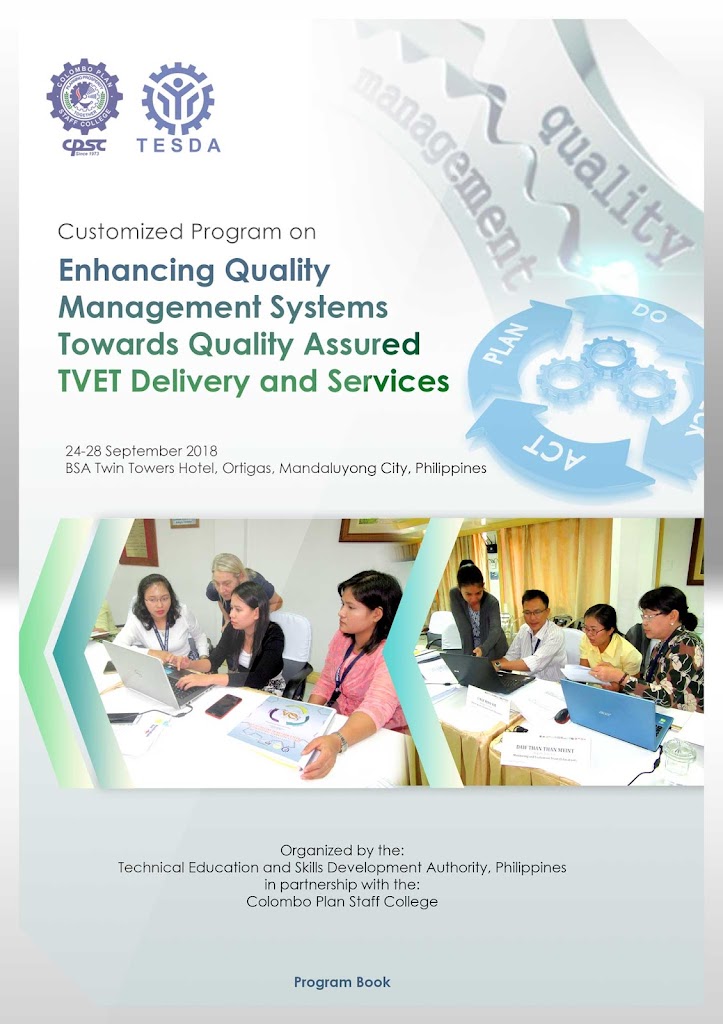
Enhancing Quality Management System (QMS) Towards Quality Assured TVET Delivery and Service


Date : Sep. 24-28, 2018 /
Venue : Manila, Philippines /
Program Type: Customized Program /

The main contents of the Program are:


Thema Papers

  • Theme Paper 1: QMS in TVET as Key to Train Skilled Workforce
  • Theme Paper 2: Quality Assurance in TVET using the EAS TVET QAF
  • Theme Paper 3: Principles and Guidelines for QMS in TVET
  • Theme Paper 4: Quality Management Tools and Implications in TVET Institutions
  • Theme Paper 5: Application of PDCA for Quality Management
  • Theme Paper 6: Continual Quality Drive of TVET Institutions through APACC and STAR
  • Theme Paper 7: M&E for QMS in TVET Institutions

Group Work Activities:

  • GWA 1: Preparing Quality Assurance Implementation Plan
  • GWA 2: Application of Quality Management in the TVIs Operations
  • GWA 3: Application of PDCA for Quality Management
  • GWA 4: Preparing Continuous Improvement Plan based on APACC and STAR Criteria
  • GWA 5: M&E for QMS in TVET Institutions